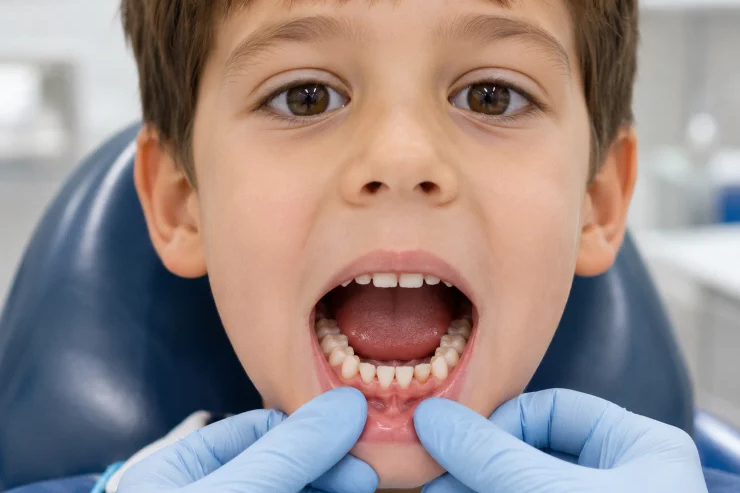
Seeing a second row of teeth in your child’s mouth can be alarming. Often called Shark teeth, it occurs when a permanent tooth begins to grow behind a baby tooth that has not yet fallen out.
Shark teeth are most often noticed around the lower front teeth when children begin losing their first baby teeth.
In most cases, the baby tooth eventually loosens and falls out without any treatment. However, a dental assessment is required when the baby tooth remains firm, the area is difficult to clean, or the permanent tooth continues to erupt farther behind it.
What Are Shark Teeth in Children?
The term “shark teeth” refers to permanent teeth growing behind baby teeth, temporarily creating two visible rows of teeth.
It most commonly occurs during mixed dentition—the stage when children have both baby teeth and permanent teeth. Parents often notice it around six years of age, when the lower permanent front teeth begin to appear.
Although the double row can look concerning, it does not automatically mean that something is wrong or that a child will need braces.
Why Do Permanent Teeth Grow Behind Baby Teeth?
As a permanent tooth develops, it normally puts pressure on the root of the baby tooth above it. Over time, the baby tooth root gradually dissolves, allowing the tooth to loosen and fall out naturally.
However, sometimes the permanent tooth may follow a slightly different eruption path behind the baby tooth. This allows the baby tooth to remain in place because its root has not dissolved enough to make it loose.
The typical causes are:
- The permanent tooth is erupting slightly behind its expected position
- The baby tooth has not started loosening
- The baby tooth root has not dissolved completely
- There is limited room in the developing dental arch
- The child’s tooth eruption pattern differs from the typical sequence
Shark teeth are especially common around the lower front teeth, but may occasionally occur elsewhere in the mouth.
Are Two Rows of Teeth Normal for a Child?
A temporary second row of teeth is not considered abnormal from a dental development perspective.
If the baby tooth is already loose and your child is comfortable, monitoring the area may be all that is needed. Once the baby tooth falls out, the permanent tooth may gradually move closer to its expected position, particularly when there is enough space within the dental arch.
This repositioning occurs gradually over several weeks or months as the jaw continues to grow and additional permanent teeth erupt.
However, not every permanent tooth moves into alignment on its own. The outcome depends on factors such as available space, crowding, and the tooth’s growing angle. Your family dentist in Mississauga can monitor these changes during routine visits.
What Should Parents Check at Home?
In addition to the appearance of teeth, parents should observe the surrounding gums, tooth mobility, and how easily the area can be cleaned.
Check whether:
- The baby tooth is loose or remains firm
- Your child experiences pain while biting or chewing
- Food repeatedly becomes trapped between the two rows of teeth
- The gums appear swollen, irritated, or unusually red
- Your child can brush the area effectively
- The permanent tooth continues to erupt
- More than one area of the mouth is affected
A loose baby tooth with no discomfort may simply need time. However, if the baby tooth remains firm while the permanent tooth continues to come out, a dental assessment is required.
When Should You Take Your Child to a Dentist?
Shark teeth are usually not a dental emergency. However, consider a professional dental evaluation if:
- The permanent tooth is erupting, but the baby tooth remains firmly in place
- The area is difficult for your child to keep clean
- Food regularly becomes trapped between the teeth
- Your child reports discomfort while chewing
- The permanent tooth appears crowded or significantly out of position
- Several permanent teeth are erupting behind baby teeth
- You are unsure whether the baby tooth should be left alone
Seek prompt dental care if your child develops significant pain, swelling, persistent bleeding, signs of infection, or difficulty eating.
A dental examination can determine whether the area simply requires monitoring or whether the retained baby tooth is interfering with normal tooth eruption.
What Happens During the Dental Visit?
During the examination, the dentist may assess:
- How loose the baby tooth is
- The position and eruption angle of the permanent tooth
- Whether there is enough room within the dental arch
- Whether plaque or food is collecting between the teeth
- The health of the surrounding gums
- How nearby permanent teeth are developing
A dental X-ray may be recommended when clinically necessary to evaluate tooth position, root development, or available space.
Ideally, dentists recommend continued monitoring rather than immediate treatment.
Does the Baby Tooth Need to Be Removed?
Not every baby tooth involved in a shark teeth pattern needs to be removed.
If the baby tooth is becoming loose and the child has no pain or cleaning problems, it may fall out naturally. If the baby tooth is already loosening and your child has no discomfort or difficulty cleaning the area, it may fall out naturally. In these situations, continued observation is enough.
Removal may be recommended if the baby tooth remains firmly in place, interferes with the growth of the permanent tooth, contributes to discomfort, or the area becomes prone to infection. The decision depends on the individual tooth and the child’s stage of development.
Parents should avoid pulling a baby tooth that is still firmly attached. Forcing it out can cause unnecessary pain, bleeding or damage to the surrounding gum tissue.
Will the Permanent Tooth Move Forward Naturally?
It is likely to do so.
Once the baby tooth falls out, the permanent tooth may gradually move forward. The tongue naturally applies gentle pressure from behind. This can help guide the tooth into a better position.
The movement does not happen overnight. It may take weeks or months.
If the tooth does not shift or crowding remains, your dentist can monitor the area during routine dental checkups.
How to Clean Around Shark Teeth
Parents can support the area with simple daily care.
Helpful steps include:
- Brush twice daily with fluoride toothpaste
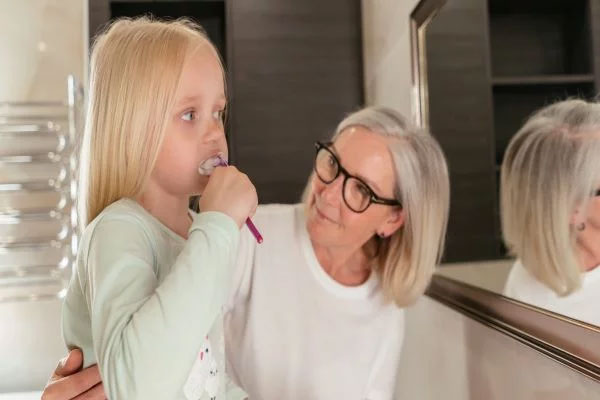
- Help your child brush around both rows
- Clean gently near the gumline
- Encourage gentle wiggling if the baby tooth is loose
- Avoid pulling a firm tooth
- Watch for discomfort or food trapping
- Maintain routine dental visits
Children may need extra help cleaning around shark teeth. Food and plaque can collect between both rows.
Shark Teeth in Children: What the Signs May Mean
| What you notice | What it may indicate | Suggested next step |
| Permanent tooth behind a loose baby tooth | A common mixed-dentition pattern | Keep the area clean and monitor it |
| Permanent tooth behind a firm baby tooth | The baby tooth may be retained longer than expected | Arrange a dental assessment |
| Food repeatedly becomes trapped | The double row is making cleaning difficult | Help with brushing and ask your dentist for cleaning guidance |
| Pain, swelling or irritated gums | The area needs professional evaluation | Contact a dentist promptly |
| Several crowded permanent teeth | There may be limited space in the dental arch | Ask the dentist to monitor developing alignment |
| The permanent tooth remains far behind after the baby tooth falls out | The tooth may need additional monitoring | Discuss the position at the next dental visit |
This table provides general guidance only. A dental examination is needed to assess your child’s specific tooth development.
Do Shark Teeth Mean a Child Needs Braces?
Not necessarily.
Shark teeth describe an eruption pattern, not an orthodontic diagnosis. A single permanent tooth growing behind a baby tooth does not confirm that a child will need braces.
The dentist will monitor how the permanent teeth align as additional teeth erupt and the jaw develops. An orthodontic assessment may be suggested if there is significant crowding, an uneven bite, insufficient space, or multiple teeth growing out of position.
Supporting Your Child’s Healthy Smile
A second row of teeth may look unusual, but in many children it represents a normal stage of dental development.
The key is knowing whether the baby tooth is loosening, whether the area is healthy, and whether the permanent tooth has enough room to develop.
At Britannia Mississauga Dental (Dr. Beena George Dentistry), we assess developing teeth carefully and recommend treatment only when it is clinically necessary. If you have questions about your child’s tooth eruption, call 905-542-9999 to arrange a dental examination.
FAQs
1. Is shark teeth in children normal?
Yes, shark teeth in children are common. They often happen when adult teeth come in before baby teeth fall out, especially around the lower front teeth.
2. Can shark teeth fix themselves?
Often, yes. Once the baby tooth falls out, the adult tooth may move forward naturally with gentle pressure from the tongue over time.
3. When should I worry about permanent teeth behind baby teeth?
Book a dental visit if the baby tooth stays firm, your child has pain, food traps often, or the adult tooth keeps growing behind it.
4. Does shark teeth mean my child will need orthodontic treatment?
Not always. Many cases settle naturally. A dentist can monitor spacing and tooth position as your child grows.
5. Can shark teeth make brushing harder?
Yes, food and plaque can collect between both rows. Parents should help children brush gently around the area until the baby tooth falls out.