
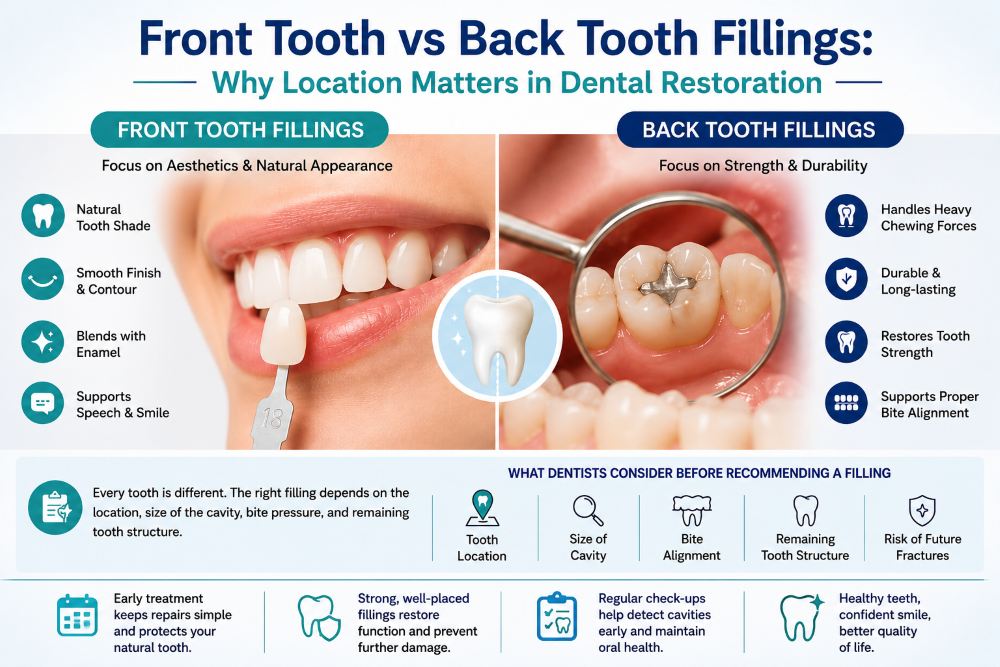
Not all dental fillings are planned the same way. A front tooth cavity presents different functional and aesthetic considerations than a cavity on a molar. The location of the tooth influences the type of restoration, the material selected, and the level of support required for long-term function.
Front teeth are important for biting, speech, and smile appearance. While back teeth carry most of the pressure from chewing. Their shape, size, visibility, and bite load all affect how a dentist restores them.
Understanding these differences can help patients make informed decisions when considering tooth filling treatment in Mississauga, and also explains why the recommendations may vary from one tooth to another.
Why Front Teeth Need a Natural-Looking Repair
Front teeth are visible when you speak, smile, and eat. Even a small cavity, chip, or worn edge can affect your appearance and dental functions.
When restoring a front tooth, the dentist usually considers:
- Tooth shade
- Edge shape
- Surface smoothness
- Enamel appearance
- Speech and teeth alignment
- How the tooth reflects light beside nearby teeth
The repair must match the surrounding tooth shade closely. It should also preserve the natural contour of the teeth, especially near the biting edge.
Tooth-coloured filling material is often used for front teeth because it can be shaped and polished to blend with the enamel. The goal is to restore the tooth without making the repair look obvious.
Why Back Teeth Need Stronger Support
Unlike front teeth, molars and premolars perform most of the chewing and grinding. These teeth absorb significant bite pressure every day.
A filling on a back tooth must do more than just close a cavity. It must tolerate repeated bite force and support the remaining tooth structure.
When planning a filling for a back tooth, dentists usually assess:
- Depth of the cavity
- The amount of remaining healthy tooth structure
- Size of the chewing surface involved
- Bite alignment
- Risk of future fractures
- Previous fillings or existing wear
A small molar cavity may be restored with a filling. A larger cavity may need a stronger approach if the damage is extensive.
This is why back-tooth fillings are planned to withstand much greater functional demands.
How Dentists Choose the Right Filling Approach
Cavity treatment requires assessment of overall oral care. As each tooth has a unique disposition, dentists evaluate several factors before recommending a restorative solution.
These may include:
Tooth Location
Visibility influences treatment planning. Since front teeth are visible when smiling and speaking, restorations are designed to blend naturally with surrounding enamel. For back teeth, strength and chewing function generally take priority.
Size of the Damaged Area
A small area of decay can often be repaired with a filling. If the cavity is large, the tooth may need additional support to remain stable.
Bite Alignment
The way upper and lower teeth meet affects how much pressure the filling receives. This is especially important for molars, where heavy bite contact can place stress on the repair.
Remaining Tooth Structure
Previous fillings, cracks, wear patterns, and existing restorations also determine the treatment planning. A filling works best when there is enough healthy tooth structure to support it. If the tooth is weakened, additional treatment may be necessary.
At Britannia Mississauga Dental (Dr. Beena George Dentistry), dental filling recommendations are based on the individual condition of the tooth rather than a standard approach for every patient.
When a Filling May Not Be Enough
Dental Fillings are effective for many small to moderate cavities. However, they may not provide enough support when the damage is extensive.
A filling may not be the right option if:
- A large part of the tooth is missing
- The tooth has deep cracks
- The cavity extends close to the nerve
- The biting surface is heavily weakened
- An old filling has left limited tooth structure
- The tooth is painful, infected, or highly sensitive
In these cases, the dentist may recommend a crown, root canal treatment, or another restorative option. The purpose is to protect the tooth, restore function, and reduce the risk of further damage.
Questions Patients Should Ask During a Dental Filling Consultation
A consultation should help patients understand both the repair and the reason behind it.
When discussing tooth filling treatment, useful questions include:
- Is the cavity small, moderate, or deep?
- Is the filling on a front tooth or a back tooth?
- Will the repair be visible when I smile?
- How much healthy tooth structure remains?
- Will my bite need to be adjusted after the filling?
- Is the tooth at risk of cracking?
- How can I care for the filling after treatment?
These questions can help clarify why a dentist may choose one filling approach over another.
Importance of Early Cavity Treatment
Early treatment allows cavity damage to be repaired with a simple filling before decay reaches deeper layers of the tooth. When identified at an early stage, treatment is often more conservative and helps preserve more natural tooth.
If decay progresses, the tooth may become sensitive, develop cracks, or experience infection. In these situations, a filling may no longer provide sufficient support, and more extensive treatment may be required.
Routine dental examinations help detect early cavities, worn restorations/fillings, and developing structural concerns before they become more complex. For patients considering tooth filling treatment in Mississauga, timely assessment can support simpler treatment and better long-term oral health outcomes.
Personalized Dental Care for Front and Back Tooth Fillings
Front teeth and back teeth perform different functions, which is why dental fillings are not planned the same way for every cavity. Factors such as tooth location, bite pressure, remaining tooth structure, and appearance all influence the most appropriate restoration.
At Britannia Mississauga Dental (Dr. Beena George Dentistry), treatment recommendations are based on a thorough assessment of the tooth and surrounding oral structures. If you would like to discuss your options for tooth filling treatment in Mississauga, contact our team at 905-542-9999 to schedule an appointment.
Frequently Asked Questions
Do front tooth fillings look natural?
Yes. Front tooth fillings can be matched closely to the shade of the existing teeth enamel. The material is shaped and polished so the repair blends with the natural tooth surface.
Are fillings on back teeth different from fillings on front teeth?
Yes. Back teeth handle more chewing pressure, so the filling must provide strength and stability. Front tooth fillings require more focus on shade, shape, and visibility.
Can a filling repair a chipped front tooth?
In many cases, yes. A small chip on a front tooth can often be repaired with tooth-coloured filling material. The dentist will assess the size, location, and bite contact before recommending treatment.
How long do dental fillings last?
The lifespan of a filling depends on its size, location, material, oral hygiene, and bite pressure. Routine dental visits help monitor the filling and overall tooth structure.
When might a crown be recommended instead of a filling?
A crown may be recommended when the tooth has lost too much structure for a filling to provide stable support. This can happen with large cavities, deep cracks, or heavily worn teeth.